

Home/ Service areas/ Utah
Service area / UT
Commercial steel framing and PEMB erection in Utah
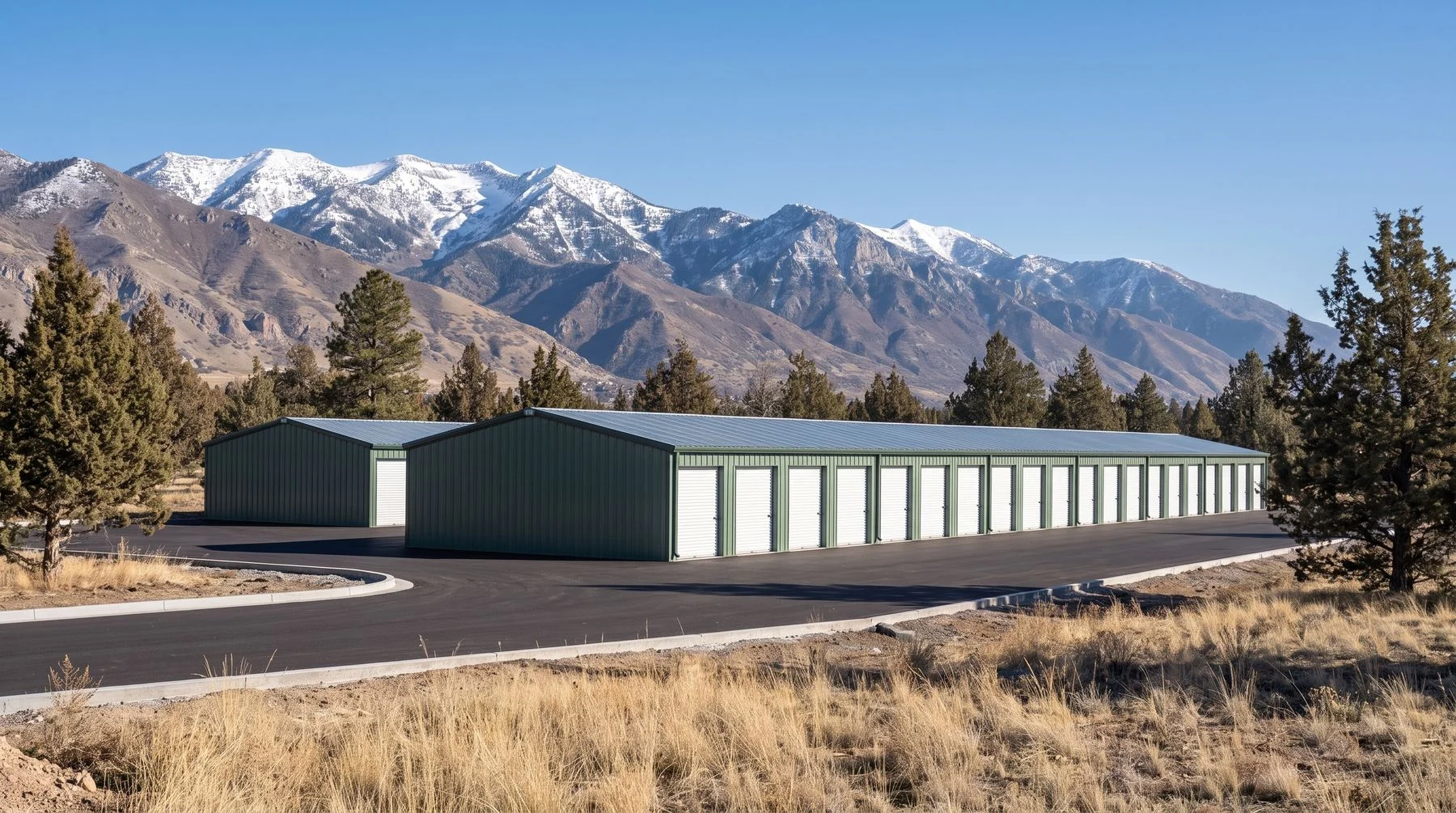
Stalcup Construction is licensed in Utah and has crews in the state right now, building nineteen drive-up storage units. We frame in cold-formed steel and erect pre-engineered buildings along the Wasatch Front and beyond it, for storage operators, developers and owners building direct.
In short
Crews on the ground right now.
Stalcup Construction is licensed in Utah and has crews working in the state right now, setting nineteen drive-up storage units. Salt Lake sits where I-15, I-80 and I-84 meet, which is why regional distribution builds there.
Core storage submarkets along the Wasatch Front are tight, so new supply is moving out along the growth corridor to the south and west.
Licensing
Licensed and insured in Utah.
Stalcup Construction holds a Utah contractor license and carries insurance for commercial work in the state. Utah is one of eight states we are licensed in, and currently the only one besides Oregon with an active Stalcup crew on the ground. License status is verifiable through the Utah Division of Professional Licensing under the company name.
Both services
Both services, across Utah.
Cold-formed steel framing
Structural and non-structural steel stud framing, our own crews on every job. The nineteen drive-up units going up in Utah right now are exactly this work, repeated across the site until the last one is set.
PEMB steel buildings
Clear-span pre-engineered buildings erected by the crews that frame the units. Distribution and fleet shells along the Wasatch Front, and the steel envelopes that storage facilities get built inside of.
What Utah is building
Three interstates meet here.
Salt Lake City sits where I-15, I-80 and I-84 meet
That is the whole reason the Wasatch Front works as a distribution base: a very large share of the western United States is inside a day's drive of it. Regional distribution, building-materials supply, fleet services and service operators all site here for that one reason, and they have been doing it for long enough that the market is mature rather than speculative.
The storage market is mature in the core and moving outward
Salt Lake, Utah, Davis and Weber counties carry most of the state's self-storage, and the core submarkets are tight. New supply is being absorbed along the Lehi, Saratoga Springs and Eagle Mountain corridor, which is where the population growth actually is.
Land for industrial outdoor storage is genuinely scarce
The Wasatch Front is hemmed in between the mountains and the lake, and the supply of yard-capable land is finite in a way it is not in Montana or Wyoming. Scarce land raises the value of whatever gets built on it, which pushes buildings to be more permanent and better engineered rather than cheaper.
The 2032 Winter Olympics are a fixed point on the horizon
Utah has a confirmed date that concentrates infrastructure and construction planning around it. That is unusual. Most markets do not get a decade of visibility on where the money is going.
What it needs built
What Utah needs built.
The core counties are close to saturated, so new supply now follows the population growth south and west out along the Lehi to Eagle Mountain corridor.
Three interstates meet here, which puts a very large share of the western United States inside a single day's drive of any Wasatch Front loading dock.
Land for outdoor storage is scarce along the Wasatch Front, so whatever does get built on it tends to be built to last rather than to the lowest number.
Why Stalcup in Utah
Crews mobilize and stay.
We are already here. Crews are in Utah now, building nineteen drive-up storage units, which answers the mobilization question before anyone has to ask it.
The range argument lands harder in this state than anywhere else we work. The same company running a nineteen-unit drive-up job also ran a seven-figure facility as general contractor in Ferndale, Washington. A developer with a small infill site and a developer with a full facility are talking to the same people and getting the same crews.
And the end-to-end point matters in a tight submarket. One contractor erects the shell and frames the units inside it, which takes a handoff out of a schedule where opening before the competition is the whole business case.
We are licensed in the state and the practical floor is around $50,000 once crews are traveling.
The job running in Utah now
Nineteen individual structures, not one long building.
Our crews are currently setting nineteen drive-up storage units, ten feet by ten feet each, in Utah.
It is worth describing what that job actually is, because it is not what most people picture. These are individual steel structures set on the asphalt rather than a single continuous building divided into bays. That changes the erection sequence, and it changes the foundation problem entirely: nineteen separate structures each sitting on their own pad rather than one long slab under a connected row.
It is a small job by the standards of the Ferndale facility, and we took it for the same reason we take the large ones. It is storage, our crews are fast at it, and the customer wanted people who had done it before.
A lot of Utah work comes straight from the developer or the operator, and we take it that way as readily as we take it through a general contractor. If you are searching for framing contractors or steel erectors in Utah, the distinction worth knowing is this: we are the erector, not the catalog.
Where we work
Where we work in Utah.
I-15 carries most of it.
Frequently asked questions
Four about this state.
Is Stalcup working in Utah now?
Is there room for new self-storage on the Wasatch Front?
Do you build small storage projects as well as large ones?
Are you licensed in Utah?
Keep going
Send a drawing set and we will price it
Crews in Utah now, and seven-figure projects run as GC.
Crews mobilize out of Central Oregon and stay on site until the work is finished.